
Ask every customer, right after the work is done, with your Google review link in the message. Google’s advice runs the same short list: remind customers with a link or QR code, reply to reviews, and value all of them (Google).
Why You Have Fewer Reviews Than You Deserve
Your happy customers paid, said thanks, & went back to their day. The link wasn’t in front of them while the job still felt good.
Customers must also be signed into a Google Account to leave a review (Google). Someone who taps your link on a phone that isn’t signed in lands on a login screen, and most people give up there.
I’ve already broken down how your reviews feed what Google and the AI assistants say about your business, over in finishing the profile itself.
The Ask: The Link, the QR Code, and the Words
Google makes the link for you, free, inside the profile you already own.
- Open your Business Profile on a computer, since the reviews QR code generates only in a computer browser (Google).
- Select Read Reviews, then Get more reviews (Google).
- Copy the link, or right-click the QR code and choose Save image as (Google).
Google’s own suggestions for where to put it: on your receipts, in thank-you emails, at the end of a chat, and printed and displayed in your store (Google). A magnet on the van door and a line in your invoice email cover most of a local service business.
A customer can’t review a profile that isn’t claimed and verified, so the Google Business Profile checklist is the first stop if yours is unfinished.
As for the words, short and to the point. “Thanks again for trusting us. If you have a moment, a review helps other folks in Affton find us.” Then the link, with no persuasive text, incentives, or coercive language when asking for reviews because it violates Google’s Fake Engagement policy (Google).
The Moment: When to Ask So People Do It
The other half of the ask is timing: ask while the work is still fresh in their hands, the same day, ideally the same hour.
Timing matters on the reading side too. Roughly 74 in every 100 people only care about reviews written in the last three months (BrightLocal). The window keeps narrowing on your older reviews: 32 in every 100 now look for reviews from the last two weeks, up from 20 the year before (BrightLocal).
Save the review link as a text template today, and send it the day each job ends. When your newest review is two years old, the customer reading it has no way to tell whether you’re still busy.
Is It Legal to Buy Google Reviews?
Buying reviews is against federal law in the United States. The FTC’s final rule, announced on August 14, 2024, prohibits the sale and purchase of fake reviews and testimonials and lets the agency seek civil penalties against knowing violators (FTC). It took effect on October 21, 2024 (FTC).
The rule names six things: fake or false reviews including AI-generated ones; paying for reviews that carry a particular sentiment, positive or negative; insider reviews that hide the writer’s connection to the business; company-controlled sites posing as independent; suppressing negative reviews with groundless legal threats or intimidation; and buying fake social-media followers or views (FTC).
The FTC rule allows incentives, as long as there’s no express or implied requirement that the review express a particular sentiment (FTC). Google is stricter on its own platform: it does not allow merchants to offer payment, discounts, or free goods and services in exchange for posting, revising, or removing a review (Google). So the free oil change is off the table on Google whatever the FTC allows, and a profile that trips the policy can end up suspended.
What Google’s Rules Let You Do
Google allows you to solicit and encourage reviews that represent a genuine experience, without offering incentives and without trying to influence the rating or the contents of the review (Google).
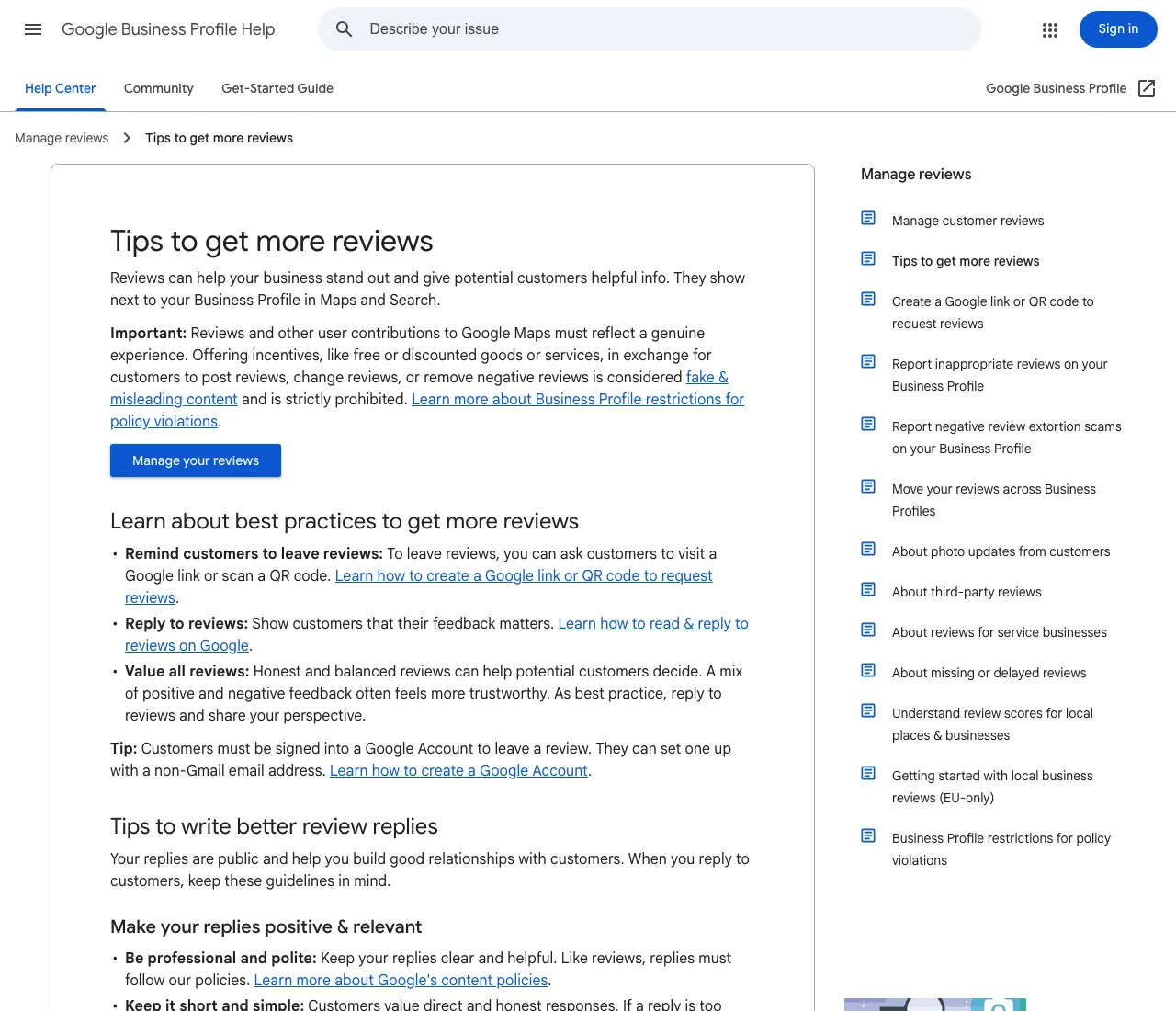
Google’s own tips page. The bolded Important paragraph is the incentive ban from the section above, & the three best practices are the whole legal playbook. Source: support.google.com.
Two limits catch good-faith owners by surprise. When soliciting reviews, merchants should not require or pressure users to leave ratings while on the premises, nor request that specific content be included (Google). Standing beside the counter while a customer types, asking them to mention a service by name, or telling staff to bring back a certain number of reviews all land on the wrong side of that.
Review gating, where happy customers get the Google link and unhappy ones get a private form, is banned by name: Google’s Rating Manipulation policy says merchants may not discourage or prohibit negative reviews, or selectively solicit positive reviews from customers (Google).
When a Google Maps user’s behavior harms Google’s users, community, or employees, Google says it may take actions ranging from suspending account privileges to account termination (Google).
How Many Reviews Do You Need, and How Fast
Short of termination, the question left is how many reviews you need. From what I’ve seen with local shops, a thousand reviews turns out to be the wrong thing to chase. BrightLocal’s survey found about 47 in every 100 people won’t use a business with fewer than 20 reviews (BrightLocal), so twenty is the number worth aiming at first, and a couple of months of asking gets you there.
Around 31 in every 100 people will only use a business rated four and a half stars or better (BrightLocal), and 56 in every 100 say the factor that matters most is a review being backed up by other reviews with similar sentiment (BrightLocal).
A steady handful every month, saying consistent things, gets you past both of those marks.
Reputation Software, and When It Earns Its Fee
A steady handful is also what reputation software sells you. Here’s what those platforms do for the fee: they send the request by text or email, chase the people who didn’t answer, and put your ratings on one dashboard. That’s a real convenience, & if you run five locations with a dozen people asking, it’s worth paying for. For one owner with one profile, the work is the link, a saved text message, and the habit of sending it the day the job ends.
The part I’d want to hear first from a vendor: the liability stays with you. The FTC states that advertising agencies, public relations firms, review brokers, and reputation management companies are not immune from liability under the rule (FTC). The profile is yours, so if a vendor’s funnel filters by sentiment before Google sees it, your listing takes the hit.
I ask for my own reviews by hand, one customer at a time. Look at the price of the tool against how many asks you send in a month, and decide from your own numbers.
Common Questions
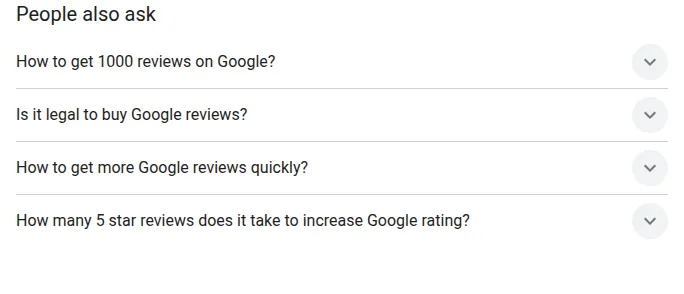
The People also ask box for this exact search, captured the day this was written. These are the four questions below, in Google’s own order. Source: Google search results.
How to get 1000 reviews on Google? At the scale of a local business, you get there by asking every single customer, for years. Buying them is prohibited under the FTC’s rule against fake reviews (FTC), and Google removes contributions that don’t reflect a genuine experience (Google).
Is it legal to buy Google reviews? Buying Google reviews is illegal in the United States. The FTC’s final rule prohibits businesses from buying fake or false reviews and from paying for reviews conditioned on a particular sentiment, and the agency can seek civil penalties against knowing violators (FTC). Google separately bans paid reviews on its own platform (Google).
How to get more Google reviews quickly? Copy your review link from your Business Profile on a computer and send it to every customer from the past month (Google). Remind them they’ll need to be signed into a Google Account (Google). Speed comes from the size of the list you send it to.
How many 5 star reviews does it take to increase Google rating? That depends on where you stand now, since the rating averages every review you already have. A business with ten reviews averaging four stars needs ten straight five-star reviews to reach the four-and-a-half mark that about 31 in every 100 people require before they’ll use you (BrightLocal).
If you’d rather have someone check the whole setup, the profile, the link, and the request you’re sending, that’s a consultation: $125 for the hour, and you leave with the list whether or not you hire me afterward. The service and its prices are posted at St. Louis SEO consultant.
I hope this helps.